Why .NET Framework?
.NET Framework is the most powerful development platform for building a variety of solutions on Windows. For example, using the .NET Framework, you can create applications for Windows Desktop, Web applications, Windows Phone applications, Windows Store applications, Windows Server, Windows Azure (cloud) as well as Bot frameworks and cognitive services.
Before exploring the .NET Framework, we first have to understand the issues/pain areas which developers have faced in other technologies -
- Programming with Win32 API - Earlier we were using Win32 API and C language. This paradigm does not offer Object Oriented Features as C is a structured language. There is no better way of memory management either as it is done manually. Using Pointers is a big pain area for developers.
- Programming with VC++ - Many of us use C++ and MFS as a programming language which offers the features of Object Oriented Features. However C++ is built on top of C language and hence the development can still cumbersome for many novice programmers who are dealing with memory management and pointers.
- Programming with Visual Basic 6.0 - Way back in 1998, VB 6.0 as a development language had made development efforts easier. For example designing complex UI, Data Centric applications and much more. But VB 6.0 is not an object oriented language and is outdated now. When designing Multi-threaded application, we still have to go back to Win32 APIs.
- Programming with COM - Component Object Model is a specification which is used for developing reusable components which can be called across the languages like VC++, Delphi. But with COM we also get "DLL Hell". DLL Hell is the issue of maintaining multiple versions of a component for multiple applications.
Under .NET Framework, many of these problems have been addressed and resolved.
Microsoft .NET Framework provides a huge no. of benefits compared with the legacy languages -
- No more COM Specifications in .NET. So, we automatically get away from DLL Hell.
- Microsoft .NET supports language integration.
- Microsoft .NET Base Class Library offers a wrapper over many raw API calls which can be used in various .NET Languages.
- You can call COM components in .NET and .NET Components in COM using interoperability.
- A Common Runtime Engine shared by all the .NET Languages.
A single framework to develop Windows/Web applications.
- We have no. of languages which make developers to adapt the .NET Framework for application development.
What is BCL?
The Base Class Library is a Common Language Infrastructure. BCL encapsulates a large number of common functionalities which are available to all the .NET Languages. BCL makes the developers life much simpler while implementing various functionalities like I/O operations, Data access operations, graphical user interfaces and interfaces to various hardware devices by encapsulating them into various namespaces and classes. It also encapsulates the services which are required by the latest real world applications. .NET Framework applications, components and the controls are built on BCL.
There are a number of namespaces and types available under various class libraries in .NET framework which can be found here https://msdn.microsoft.com/en-us/library/gg145045(v=VS.110).aspx
Explain CLR, CTS, CLS under .NET Framework?
Common Language Runtime is one of the main building blocks of Microsoft .NET Framework which is responsible for performing various operations under .NET Framework.

When you design the application using Microsoft .NET languages like C#.NET or VB.NET, the language has its own complier which compiles the code into common format that is CIL [Common Intermediate Language]. Then CIL gets targeted to CLR which in turn performs many operations. It converts CIL into Native code with the help of JIT.
CLR also performs various other operations like Memory Management, Application Execution, Thread Management, Security checks, load the required assemblies and their types. The code which is managed by CLR is also known as Managed Code. All the managed languages are handled by a single runtime that is CLR.
Common Type System (CTS) defines how the types are defined and used in the Common Language Runtime. CTS provides cross-language integration, type safety, and high-performance code execution. The Common Type System for language integration works as follows -

When you define an integer variable in VB.NET and declare integer in C#.NET, both the languages share the same type which is Int32, available under .NET Framework.
CTS defines rules which must be followed by languages in order to make objects written in one language callable in other languages.
Microsoft .NET Framework provides various primitive data types which can be used while developing applications using various languages.
Common Language Specification (CLS) is a set of rules. CLS rules also define a subset of CTS. By defining components using CLS features only, developers are guaranteed to make use of these components in all the other languages which are CLS compliant languages. Most of the types which are defined under .NET framework are CLS complaint.
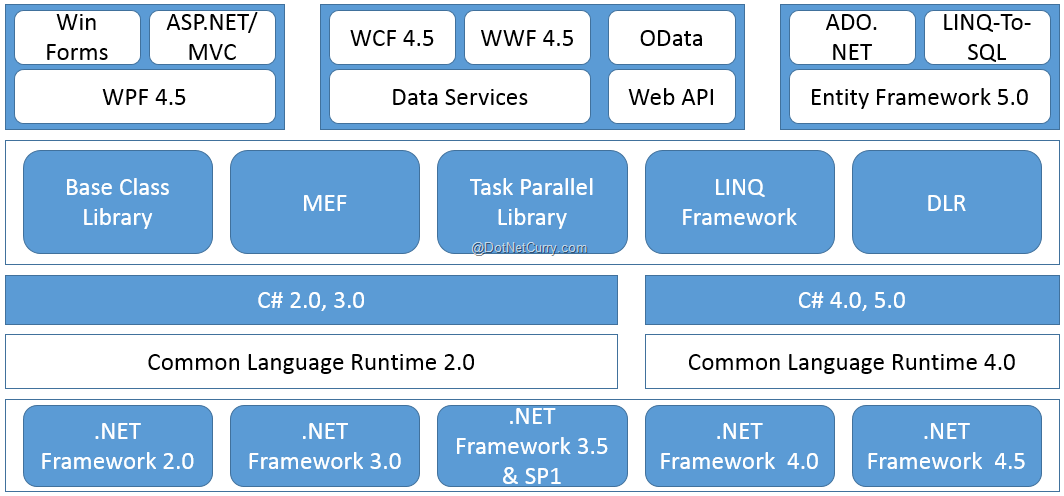
What are the different versions of .NET Framework?
Following are the different versions of the Microsoft .NET Framework -

There are two more versions of .NET Framework released after v4.5. .NET Framework 4.6 was released in July 2015 and came with support for a new just-in-time compiler (JIT) for 64-bit systems called RyuJIT. .NET Framework 4.6.1 was announced in November 2015.
What is an application server?
As defined in Wikipedia, an application server is a software engine that delivers applications to client computers or devices. The application server runs your server code. Some well known application servers are IIS (Microsoft), WebLogic Server (BEA), JBoss (Red Hat), WebSphere (IBM).
Compare C# and VB.NET
A detailed comparison can be found over here.
What is a base class and derived class?
A class is a template for creating an object. The class from which other classes derive fundamental functionality is called a base class. For e.g. If Class Y derives from Class X, then Class X is a base class.
The class which derives functionality from a base class is called a derived class. If Class Y derives from Class X, then Class Y is a derived class.
What is an extender class?
An extender class allows you to extend the functionality of an existing control. It is used in Windows forms applications to add properties to controls.
A demonstration of extender classes can be found over here.
What is inheritance?
Inheritance represents the relationship between two classes where one type derives functionality from a second type and then extends it by adding new methods, properties, events, fields and constants.
C# support two types of inheritance:
· Implementation inheritance
· Interface inheritance
What is implementation and interface inheritance?
When a class (type) is derived from another class(type) such that it inherits all the members of the base type it is Implementation Inheritance.
When a type (class or a struct) inherits only the signatures of the functions from another type it is Interface Inheritance.
In general Classes can be derived from another class, hence support Implementation inheritance. At the same time Classes can also be derived from one or more interfaces. Hence they support Interface inheritance.
Source: Exforsys.
What is inheritance hierarchy?
The class which derives functionality from a base class is called a derived class. A derived class can also act as a base class for another class. Thus it is possible to create a tree-like structure that illustrates the relationship between all related classes. This structure is known as the inheritance hierarchy.
How do you prevent a class from being inherited?
In VB.NET you use the NotInheritable modifier to prevent programmers from using the class as a base class. In C#, use the sealed keyword.
When should you use inheritance?
Read this.
Explain Different Types of Constructors in C#?
There are four different types of constructors you can write in a class -
1. Default Constructor
2. Parameterized Constructor
3. Copy Constructor
4. Static Constructor
Read more about it at https://www.dotnetcurry.com/csharp/1193/csharp-constructor-types-interview-question
Define Overriding?
Overriding is a concept where a method in a derived class uses the same name, return type, and arguments as a method in its base class. In other words, if the derived class contains its own implementation of the method rather than using the method in the base class, the process is called overriding.
Can you use multiple inheritance in .NET?
.NET supports only single inheritance. However the purpose is accomplished using multiple interfaces.
Why don’t we have multiple inheritance in .NET?
There are several reasons for this. In simple words, the efforts are more, benefits are less. Different languages have different implementation requirements of multiple inheritance. So in order to implement multiple inheritance, we need to study the implementation aspects of all the languages that are CLR compliant and then implement a common methodology of implementing it. This is too much of efforts. Moreover multiple interface inheritance very much covers the benefits that multiple inheritance has.
What is an Interface?
An interface is a standard or contract that contains only the signatures of methods or events. The implementation is done in the class that inherits from this interface. Interfaces are primarily used to set a common standard or contract.
When should you use abstract class vs interface or What is the difference between an abstract class and interface?
I would suggest you to read this. There is a good comparison given over here.
What are events and delegates?
An event is a message sent by a control to notify the occurrence of an action. However it is not known which object receives the event. For this reason, .NET provides a special type called Delegate which acts as an intermediary between the sender object and receiver object.
What is business logic?
It is the functionality which handles the exchange of information between database and a user interface.
What is a component?
Component is a group of logically related classes and methods. A component is a class that implements the IComponent interface or uses a class that implements IComponent interface.
What is a control?
A control is a component that provides user-interface (UI) capabilities.
What are the differences between a control and a component?
The differences can be studied overhere.
What are design patterns?
Design patterns are common solutions to common design problems.
What is a connection pool?
A connection pool is a ‘collection of connections’ which are shared between the clients requesting one. Once the connection is closed, it returns back to the pool. This allows the connections to be reused.
What is a flat file?
A flat file is the name given to text, which can be read or written only sequentially.
What are functional and non-functional requirements?
Functional requirements defines the behavior of a system whereas non-functional requirements specify how the system should behave; in other words they specify the quality requirements and judge the behavior of a system.
E.g.
Functional - Display a chart which shows the maximum number of products sold in a region.
Non-functional – The data presented in the chart must be updated every 5 minutes.
What is an Assembly? Explain different types of Assemblies?
An assembly is a final deployable unit which can versioned and secured. The assembly can also be termed as a reusable collection of types and resources which work together as a logical unit of functionalities in .NET. .NET assemblies can be designed as executable (.EXE) or reusable component (.DLL). An assembly contains one or more managed types which can be made accessible to the unit or outside the unit.
Assembly gets divided into four different parts.
• Manifest.
• Type Metadata.
• Intermediate Language.
• Resources.
Manifest - contains information about the assembly like Version of an assembly, the public key in case the assembly is shared assembly and the culture information. It also contains the security demands to verify this assembly. CLR uses the manifest to load the assembly.
Type Metadata - gives the complete information about the types which are available in the assembly like Class, Structure, Interface, Enum, and the methods, their parameters. The compilers automatically generate this metadata. You can make use of this Type Metadata to dynamically load the types using .NET Reflection.
Intermediate Language - It a code generated by the language specific compiler. It is also known as Machine independent code which can be compiled on one machine and can be deployed on another. CLR targets this code to JIT to convert it into processor depend on code which can be further executed.
Resources - Assembly can also contain the embedded resources like icons, images, string tables media clips.
You can see this information using a .NET framework utility called ILDASM.EXE
Microsoft .NET support different types of assemblies.
• Private Assembly - Private Assemblies are the assemblies which are only known to the application to which it has been referenced. By default, the assemblies are always private when you create and reference them. The private assembly gets stored in the application folder which is using the assembly.
Private assemblies are identified with the help of name of an assembly and version of an assembly. But the versions does not really come into the picture as the referenced assembly is in the same folder of your application.
• Shared/Global/Public Assembly - Global/Public Assemblies are the assemblies which are shared across multiple applications. These assemblies are installed into Global Assembly Cache which acts as a shared area for all the assemblies.
Global Assembly is identified with the four-part assembly name - Name of an Assembly, Version of an assembly, and Culture of an Assembly and Public Key Token of an assembly. Global Assembly Cache can contain different versions of an assembly.
You can install a public/global assembly into Global Assembly Cache [GAC] using GACUTIL.EXE tool.
• Satellite Assembly - Satellite Assemblies are used to build multi-lingual assemblies for applications. Satellite assemblies contain information about the cultures. Satellite assemblies are used to display the data in multiple languages according to Country/Region.
What is the global assembly cache (GAC)?
GAC is a machine-wide cache of assemblies that allows .NET applications to share libraries. GAC solves some of the problems associated with dll’s (DLL Hell).
What is a stack? What is a heap? Give the differences between the two?
Stack is a place in the memory where value types are stored. Heap is a place in the memory where the reference types are stored.
Check this link for the differences.
What is instrumentation?
It is the ability to monitor an application so that information about the application’s progress, performance and status can be captured and reported.
What is code review?
The process of examining the source code generally through a peer, to verify it against best practices.
What is logging?
Logging is the process of persisting information about the status of an application.
What are mock-ups?
Mock-ups are a set of designs in the form of screens, diagrams, snapshots etc., that helps verify the design and acquire feedback about the application’s requirements and use cases, at an early stage of the design process.
What is a Form?
A form is a representation of any window displayed in your application. Form can be used to create standard, borderless, floating, modal windows.
What is a multiple-document interface(MDI)?
A user interface container that enables a user to work with more than one document at a time. E.g. Microsoft Excel.
What is a single-document interface (SDI) ?
A user interface that is created to manage graphical user interfaces and controls into single windows. E.g. Microsoft Word
What is BLOB ?
A BLOB (binary large object) is a large item such as an image or an exe represented in binary form.
What is ClickOnce?
ClickOnce is a new deployment technology that allows you to create and publish self-updating applications that can be installed and run with minimal user interaction.
What is object role modeling (ORM) ?
It is a logical model for designing and querying database models. There are various ORM tools in the market like CaseTalk, Microsoft Visio for Enterprise Architects, Infagon etc.
What is a private assembly?
A private assembly is local to the installation directory of an application and is used only by that application.
What is a shared assembly?
A shared assembly is kept in the global assembly cache (GAC) and can be used by one or more applications on a machine.
What is the difference between user and custom controls?
User controls are easier to create whereas custom controls require extra effort.
User controls are used when the layout is static whereas custom controls are used in dynamic layouts.
A user control cannot be added to the toolbox whereas a custom control can be.
A separate copy of a user control is required in every application that uses it whereas since custom controls are stored in the GAC, only a single copy can be used by all applications.
Where do custom controls reside?
In the global assembly cache (GAC).
What is a third-party control ?
A third-party control is one that is not created by the owners of a project. They are usually used to save time and resources and reuse the functionality developed by others (third-party).
What is a binary formatter?
Binary formatter is used to serialize and deserialize an object in binary format.
What is Boxing/Unboxing?
Boxing is used to convert value types to object.
E.g. int x = 1;
object obj = x ;
Unboxing is used to convert the object back to the value type.
E.g. int y = (int)obj;
Boxing/unboxing is quiet an expensive operation.
What is a COM Callable Wrapper (CCW)?
CCW is a wrapper created by the common language runtime(CLR) that enables COM components to access .NET objects.
What is a Runtime Callable Wrapper (RCW)?
RCW is a wrapper created by the common language runtime(CLR) to enable .NET components to call COM components.
What is a digital signature?
A digital signature is an electronic signature used to verify/gurantee the identity of the individual who is sending the message.
What is garbage collection and explain its different generations?
Garbage collector is a part of Common Language Runtime, which does automatic memory management for your application. When you create an object in your application, CLR allocates the memory for that object on Managed Heap.
Garbage collector gives number of benefits like -
Automatic Memory Management - You can build your application without thinking about how to free the memory as Garbage Collector gets called automatically by CLR.
Garbage Collector does proficient memory management for your objects.
Garbage Collector does automatic reclaim of the memory for those objects which are not in use and which are marked for deletion.
Garbage collector allocates the memory for objects in such a way that one object will not be able to use other object data accidently.

The Managed Heap is a memory area where a series of managed objects are stored and managed. As shown in the above diagram, the managed heap gets divided into three different sections which are known as Generations.
Generation 0 - This is the first generation under managed heap which is used to store and manage short-lived objects. All small size objects usually get allocated on Generation 0. When garbage collector reclaims the memory, it always reclaims the memory from generation 0 by default. The objects which are survived in Generation 0 will be pushed towards the generation 1.
Generation 1 - This generation again contain the short-lived objects and the objects which are survived from Generation 0. The objects which are survived in Generation 1 will be pushed towards the generation 2.
Generation 2 - This generation contains the long lived objects which are survived from multiple generations and are used till the process is running.
Garbage Collector first looks for the free memory in generation 0 which can be used to allocate the memory for the new object. The objects are always created in contagious memory. If the garbage collector finds sufficient memory for the new object, it does not search for the dead object and hence memory allocation process is always faster. But in case, sufficient memory is not available; then garbage collector reclaims the memory of the objects which are dead or not getting used for a long time.
When Garbage collector gets executed, it first of all, finds all the live objects. After this garbage collector updates the addresses of objects which will be compacted. Then it reclaims the memory of all the dead objects. Once the memory is reclaimed, it moves the lived objects to the next Generation. For example, the objects which live through in Generation 0 will be moved towards Generation 1. The objects which survived in generation 1 will be moved towards Generation 2. The objects which survived in Generation 2 will stay in Generation 2 only.
What is Application Domain and how does it work?
Windows Operating Systems load a set of resources like .EXE, DLLs and allocate the memory for those resources in an area called as Process. Windows OS creates a separate and isolated area for each running application. Making separate isolation area for each application, makes the process more secure and stable. In case, one process fails, it does not affect the other process.
.NET applications, however, are not hosted like traditional applications by Windows Operating System. Under .NET, .EXEs are hosted under a process by logical partitioning which is known as "Application Domain". Now you can host multiple application domains under one single process.

Application Domains consume less memory and power for processing the applications compared to the traditional processes for each application. In case one application domain fails, the other application domain will work as-is without any effects. You can also stop one application domain without affecting another application domain or without stopping an entire process.
One Application Domain cannot share/access the data from other Application Domain which is running within the same Domain or other Domain.
What is globalization?
Globalization is the process of customizing applications that support multiple cultures and regions.
What is localization?
Localization is the process of customizing applications that support a given culture and regions.
What is MIME?
The definition of MIME or Multipurpose Internet Mail Extensions as stated in MSDN is “MIME is a standard that can be used to include content of various types in a single message. MIME extends the Simple Mail Transfer Protocol (SMTP) format of mail messages to include multiple content, both textual and non-textual. Parts of the message may be images, audio, or text in different character sets. The MIME standard derives from RFCs such as 2821 and 2822”. Quoted from here.
I hope you liked these questions and I thank you for viewing them. I thank Pravin Dabade for contributing some of the .NET Interview question and answers.
This article has been editorially reviewed by Suprotim Agarwal.
C# and .NET have been around for a very long time, but their constant growth means there’s always more to learn.
We at DotNetCurry are very excited to announce The Absolutely Awesome Book on C# and .NET. This is a 500 pages concise technical eBook available in PDF, ePub (iPad), and Mobi (Kindle).
Organized around concepts, this Book aims to provide a concise, yet solid foundation in C# and .NET, covering C# 6.0, C# 7.0 and .NET Core, with chapters on the latest .NET Core 3.0, .NET Standard and C# 8.0 (final release) too. Use these concepts to deepen your existing knowledge of C# and .NET, to have a solid grasp of the latest in C# and .NET OR to crack your next .NET Interview.
Click here to Explore the Table of Contents or Download Sample Chapters!
Was this article worth reading? Share it with fellow developers too. Thanks!
Suprotim Agarwal, MCSD, MCAD, MCDBA, MCSE, is the founder of
DotNetCurry,
DNC Magazine for Developers,
SQLServerCurry and
DevCurry. He has also authored a couple of books
51 Recipes using jQuery with ASP.NET Controls and
The Absolutely Awesome jQuery CookBook.
Suprotim has received the prestigious Microsoft MVP award for Sixteen consecutive years. In a professional capacity, he is the CEO of A2Z Knowledge Visuals Pvt Ltd, a digital group that offers Digital Marketing and Branding services to businesses, both in a start-up and enterprise environment.
Get in touch with him on Twitter @suprotimagarwal or at LinkedIn